“90% of our data lives inside Salesforce… we’d be crazy not to use Agentforce.”
This CIO’s reasoning reveals why some organizations succeed with AI while others fail: they think architecturally about where AI lives in their technology stack. So how do you make your Enterprise AI architecture decision?
Two Paths Emerge
Our research shows the enterprise AI market has crystallized around two distinct approaches:
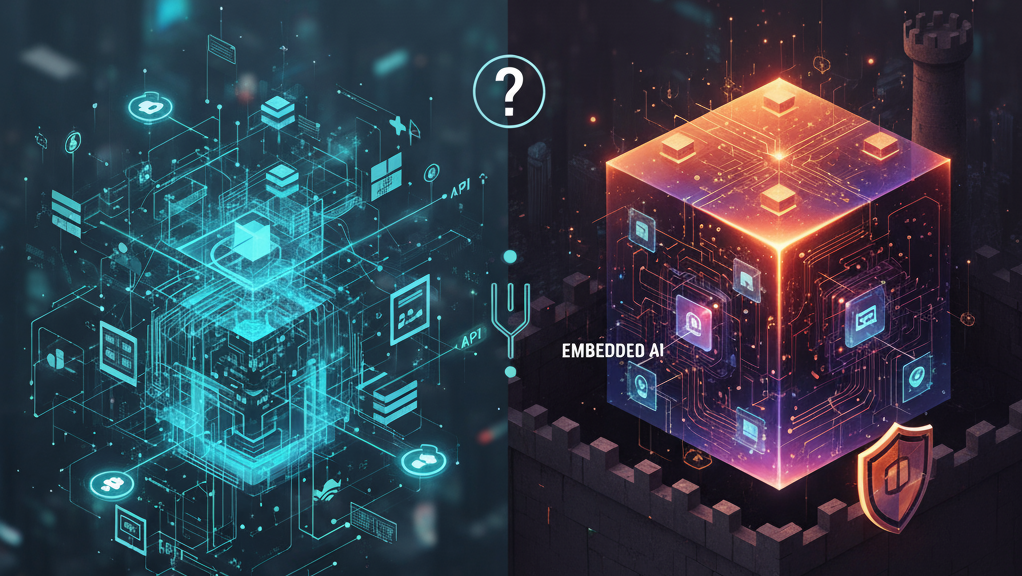
Overlay AI sits across multiple systems, connecting via APIs. Examples include Glean for enterprise search and Intercom’s Fin for customer service. These solutions deliver speed and flexibility. They’re perfect for quick wins without IT transformation.
But they expand your security attack surface and create governance challenges.
Embedded AI integrates deeply within primary platforms like Salesforce’s Agentforce, Microsoft’s Copilot, or Google’s Gemini. They operate within established security perimeters and leverage comprehensive business context.
The tradeoff? It may take up to “eighteen months of groundwork” for meaningful deployment, even with consolidated data. That makes determining your Enterprise AI architecture decision that much harder.
The Winning Strategy
Most organizations assume they must choose between overlay speed and embedded security. But the leaders we studied don’t see it as an either/or decision, but rather, they design hybrid architectures that capture both benefits.
These organizations use overlay AI for experimentation, rapid iteration, and user-facing intelligence, while anchoring critical reasoning and data access inside secure, embedded platforms like Agentforce. They treat each layer as part of a unified system, ensuring consistent governance, traceability, and model observability across boundaries.
This layered approach creates agility without fragmentation. It lets teams innovate fast where it’s safe to do so and scale confidently once value is proven.
Our full research paper reveals what the most sophisticated organizations are doing, a Value-Cost-Risk framework featuring nine decision factors to guide these choices, and differentiated recommendations for executives, line-of-business leaders, and AI vendors.
The architecture decision isn’t just technical—it’s strategic.
Sign up to get notified when the full research paper is published, including the complete framework and stakeholder-specific guidance.