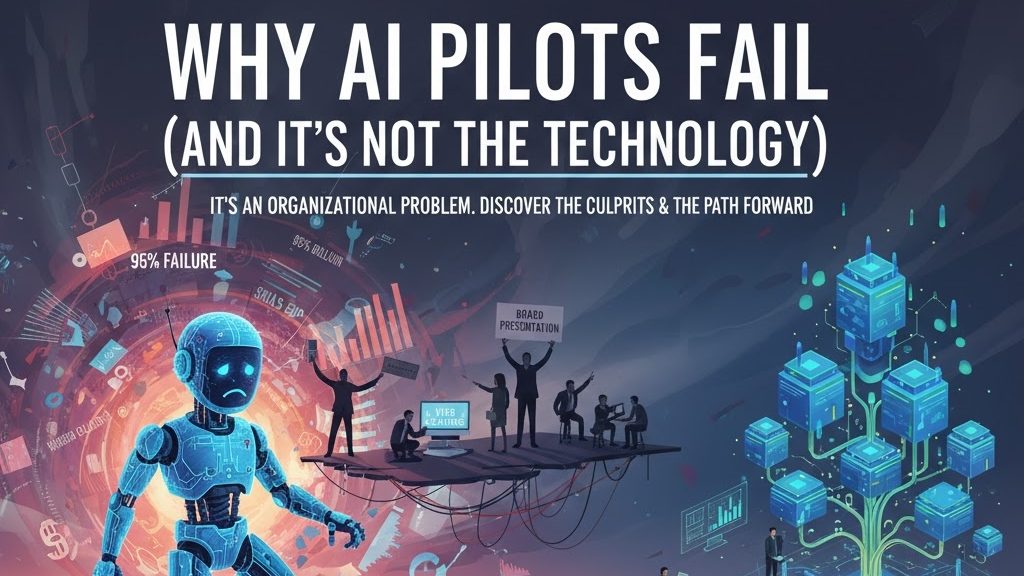
Gartner forecasts that organizations will spend $644 billion on generative AI in 2025. Yet MIT’s 2025 State of AI in Business study claims that 95% of AI pilots fail to deliver rapid revenue impact, and only 4% of companies create substantial value from their investments, according to BCG’s “AI Maturity Matrix” report.
The disconnect is stark: massive investment, minimal returns. What’s going wrong? Our research finds it isn’t just a technology problem. It’s an organizational one.
The Culprits Behind AI Disillusionment
Our research with 48 enterprise AI leaders reveals four interconnected drivers of failure:
Executive pressure creates what one Fortune 500 IT leader calls a “rat race… everyone rushes to say, ‘I implemented AI,’” prioritizing board presentations over business value. The result? Scattered pilots that chase low-hanging fruit instead of business outcomes, with some CIOs relegated to order-takers implementing technology they don’t fully understand under impossible timelines.
Skills shortages plague every level. Leaders lack AI literacy to evaluate solutions. Technical teams resort to “vibe coding” without proper expertise. Organizations default to familiar vendors: “If it’s in the Microsoft shop, I’m buying it; I’m not talking to startups.” One Fortune 500 IT decision maker lamented: “We have a lot of legacy people, and for them to understand, catching up is a big challenge.”
The promise-reality gap has vendors overselling while buyers underestimate complexity. “Vendor claims are through the roof… customers are so confused,” one consultant reports. AI sales teams struggle to articulate business value, yet face quotas pressuring them to sell.
But the most critical mistake? Treating AI like any other technology purchase.
Unlike traditional software that remains stable for years, AI evolves continuously with each model update, requiring new skills in prompt engineering, hallucination detection, and workflow integration. As one GenAI consultant explains: “AI needs to be thought of as a capability… capabilities are grown; technology is purchased.”
The Path Forward
The organizations breaking through aren’t buying different technology, but rather they’re making fundamentally different architectural decisions about how AI integrates with their existing systems.
Stay tuned for our next post revealing the architectural framework that separates AI success from failure.