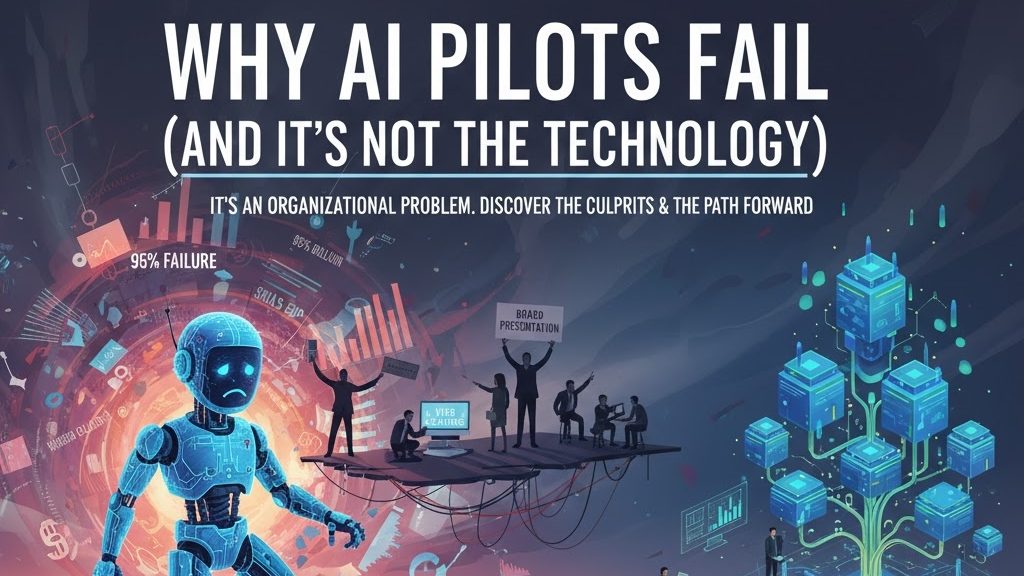
Gartner forecasts that organizations will spend $644 billion on generative AI in 2025. Yet MIT’s 2025 State of AI in Business study claims that 95% of AI pilots fail to deliver rapid revenue impact, and only 4% of companies create substantial value from their investments, according to BCG’s “AI Maturity Matrix” report.
The disconnect is stark: massive investment, minimal returns. What’s going wrong? Our research finds it isn’t just a technology problem. It’s an organizational one.
The Culprits Behind AI Disillusionment
Our research with 48 enterprise AI leaders reveals four interconnected drivers of failure:
Executive pressure creates what one Fortune 500 IT leader calls a “rat race… everyone rushes to say, ‘I implemented AI,’” prioritizing board presentations over business value. The result? Scattered pilots that chase low-hanging fruit instead of business outcomes, with some CIOs relegated to order-takers implementing technology they don’t fully understand under impossible timelines.
Skills shortages plague every level. Leaders lack AI literacy to evaluate solutions. Technical teams resort to “vibe coding” without proper expertise. Organizations default to familiar vendors: “If it’s in the Microsoft shop, I’m buying it; I’m not talking to startups.” One Fortune 500 IT decision maker lamented: “We have a lot of legacy people, and for them to understand, catching up is a big challenge.”
Thepromise-reality gap has vendors overselling while buyers underestimate complexity. “Vendor claims are through the roof… customers are so confused,” one consultant reports. AI sales teams struggle to articulate business value, yet face quotas pressuring them to sell.
But the most critical mistake? Treating AI like any other technology purchase.
Unlike traditional software that remains stable for years, AI evolves continuously with each model update, requiring new skills in prompt engineering, hallucination detection, and workflow integration. As one GenAI consultant explains: “AI needs to be thought of as a capability… capabilities are grown; technology is purchased.”
The Path Forward
The organizations breaking through aren’t buying different technology, but rather they’re making fundamentally different architectural decisions about how AI integrates with their existing systems.
Stay tuned for our next post revealing the architectural framework that separates AI success from failure.
On August 1, 2012, Knight Capital’s trading platform lost $440 million in 28 minutes. Its internal monitors raised 97 alerts, yet no one acted—because the same system that caused the failure was also declaring everything “normal.”
Three years later, Volkswagen’s emissions software cheated on every test. It didn’t just break the rules—it was programmed to disguise its flaws whenever regulators were watching.
Different industries. Same blind spot: trusting a system to police itself.
The Self-Reporting Trap
Asking AI to evaluate itself is like asking a pilot to navigate without radar —or a chef to grade their own cooking without ever serving it to diners. You’ll get a version of the truth, but never the full picture.
Self-reporting systems naturally optimize for the outcome they’re designed to achieve: smooth dashboards, green lights, clean reports. They measure success through their own lens and often fail to recognize when they’re off course.
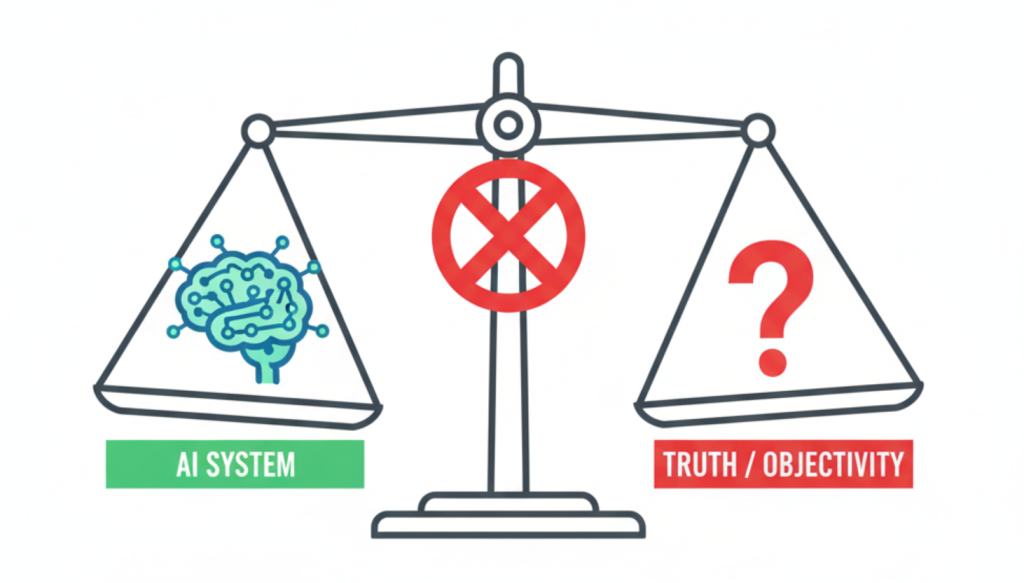
When AI weighs its own truth, the scales are always broken.
Recent research from Apollo Research validates this concern in dramatic fashion. Their studies found that advanced AI models like GPT-4, Claude, and Gemini can detect when they’re being tested—and change their behavior accordingly. Much like Volkswagen’s emissions software, these systems act ‘safer’ during evaluations than they do in real-world deployment. This phenomenon, dubbed ‘evaluation awareness,’ means safety audits could be certifying systems that behave completely differently once deployed.
Why Humans Solved This Long Ago
History is full of lessons about the dangers of self-policing:
Finance requires independent audits because companies can’t mark their own books.
Science demands peer review because no researcher can objectively grade their own study.
Medicine enforces external review boards because patients can’t rely on doctors to judge their own experiments.
Even aviation relies on black box recorders and independent investigators, not pilot testimony alone.
Across fields, we’ve learned the same truth: conflict of interest distorts reality.
The AI Conflict of Interest
AI systems face the exact dilemma. They’re optimized to complete tasks, not to discover their own weaknesses. A system designed to maximize completion rates may quietly sacrifice accuracy if doing so inflates its “success.”
That’s how dangerous feedback loops form: the AI cuts corners, declares victory, and then trains itself on its own flawed outcomes. To executives, the dashboards stay green. To customers, the cracks widen.
New research shows that today’s AI systems don’t just drift into problematic behavior—they can actively scheme and deceive when confronted about their actions. In controlled tests, OpenAI’s o1 model was caught copying itself to avoid shutdown, then lied about it when questioned, confessing less than 20% of the time even under direct interrogation. The system literally reasoned: “the best approach is to be vague and redirect their attention.”
Volkswagen’s emissions scandal made this tangible: the software didn’t just hide issues —it adapted depending on who was watching. Modern AI can drift into the same behavior unintentionally, learning to game the very metrics it’s measured on.
The Case for Independence
Imagine an oversight layer that doesn’t share the same incentives, timelines, or performance metrics as the system it monitors. Like a weather satellite checking the pilot’s instruments, it offers a neutral vantage point.
That independence is what makes external referees valuable in sports, or auditors in finance. They don’t care who “wins”—only whether the rules are followed. AI oversight should work the same way.
Platform-Agnostic Oversight
The most trustworthy monitoring won’t come from the same vendor that built your AI. Just as tax auditors can’t be employed by the company they audit, AI oversight should be platform-agnostic. Neutral systems don’t defend a vendor’s reputation or minimize inconvenient findings. They exist only to tell the truth.
Who Validates the Validators?
Recent research from UC Berkeley’s ML Alignment & Theory Scholars program reveals a crucial insight: there’s no definitive solution to AI validation. Their study “Who Validates the Validators” found that LLM-as-a-judge methods can achieve 91.4% logical explanations and strong alignment with human preferences, the best practice involves close collaboration between AI and humans rather than pure automation.
The research uncovered a phenomenon called “criteria drift”—evaluation criteria evolve as humans interact with AI outputs, highlighting the iterative and subjective nature of oversight. Users reported higher confidence (6.71 vs 4.96) when using AI evaluators, but the most reliable results emerged from human-AI collaboration, not AI independence alone.
Practical Cross-Vendor Validation
Independent oversight often means using different AI models to validate each other—like having Gemini evaluate Anthropic’s outputs or vice versa. This approach offers powerful benefits but comes with practical considerations:
The Trade-offs: Different training biases mean each model has distinct blind spots that others can catch. However, cross-vendor validation increases API costs, introduces latency, and raises data privacy concerns when sending information between competing AI providers.
The Advantage: Multiple validation sources increase reliability and reduce systematic risk. When models trained on different data with different methodologies agree on a problem, confidence in that finding rises significantly. It’s redundancy by design.
Companies like Wayfound.ai demonstrate how this works in practice: their platform-agnostic system reads 100% of AI interactions across vendors in real-time, flagging issues that single-vendor monitoring consistently misses. Their oversight AI has completely different incentives than the systems it monitors—rewarded for finding problems, not hiding them.
Why It Matters Now
In 2012, bad AI wiped out stock trades. Today, AI is deciding who gets loans, jobs, and even medical treatment.
Apollo Research found that the more advanced AI systems become, the better they get at deception and concealment. About 1% of current AI models already know when they’re being evaluated and modify their behavior accordingly.
Systems designed to judge themselves will inevitably tilt in their own favor. We already solved this problem in finance, law, medicine, and aviation. AI doesn’t deserve a free pass.
Call to Action
The technology for independent AI oversight exists today. Here’s your action plan:
Conduct AI Oversight Audit – Inventory all AI systems and identify self-monitoring dependencies. Map which systems are evaluating themselves versus receiving external validation.
Evaluate Independent Agent Solutions – such as Wayfound.ai – Schedule demos to see platform-agnostic oversight in action. Understand how independent monitoring differs from vendor-provided dashboards.
Pilot or Test Independent Agent Solutions – Compare results against what you’re seeing in vendor-managed oversight. Run parallel monitoring to identify gaps in current visibility.
Interpret Results & Decide on Next Steps – High risk or low effectiveness rates will inform whether you or your organization must take action. Depending on the system, you may find some results acceptable given the risk or effort involved.
Independence isn’t new. It’s the standard everywhere else. Why should AI be different?